
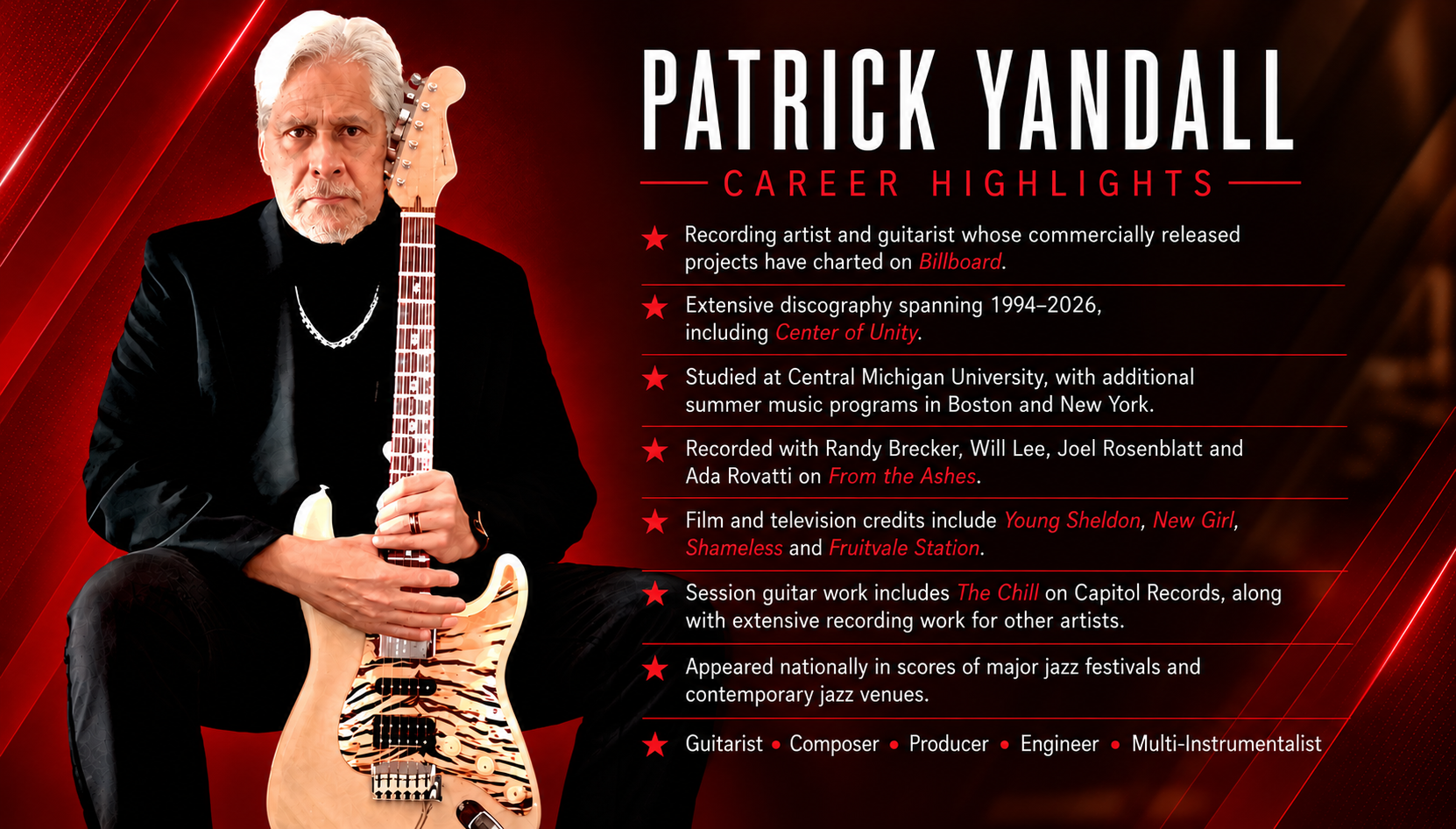
Patrick Yandall: The Music Is the Connection
Guitarist and composer Patrick Yandall reflects on a life built around music, the artists who shaped him, the injury that nearly took the guitar away, and why connection still matters more than category.
There is a revealing moment early in Paula Atherton’s conversation with Patrick Yandall when the discussion turns to people who insist they do not like jazz until they hear the right performance.
Yandall had recently performed at Humphreys Backstage in San Diego when a friend, unfamiliar with jazz, attended with his wife. Afterward, the friend admitted that he had expected to be bored by an evening without a vocalist. Instead, both walked away surprised by how deeply instrumental music had reached them.
For Yandall, that reaction gets remarkably close to the reason for making music in the first place. “I’m not trying to play above anybody’s head,” he tells Atherton. “I’m trying to connect with you somehow.”
That idea of connection runs throughout their conversation. It appears in the way Yandall talks about audiences, the musicians who influenced him, improvisation, his own recordings and even the injury that temporarily separated him from the instrument he had played for most of his life.
A Musical Life That Started Early
Long before the albums, recording sessions and collaborations, Yandall was a teenager in Michigan trying to balance school with something resembling a professional musician’s schedule. His father had been a musician in the Army, and Yandall began playing young. By ninth grade, he was already performing in clubs around Michigan, sometimes working Thursday through Sunday nights before returning to school. He remembers the Detroit-area music scene of the period as vibrant and formative.
His musical vocabulary was equally broad. Jimi Hendrix was there. So were Steely Dan, George Benson, R&B and funk. But an early Jeff Lorber concert would make a particularly lasting impression.
Yandall’s older brother introduced him to Lorber’s instrumental music and then took him to a performance near Detroit. Yandall remembers being struck by the sound and energy of the music. Onstage was a young saxophonist with long hair and ripped jeans who seemed to bring the audience to its feet after every solo. Lorber kept announcing his name, but it would only be later that Yandall realized he had been watching a young Kenny G.
For a young guitarist already drawn to R&B, funk, rock and jazz, the experience opened another door. Instrumental music did not have to belong neatly to one world. It could pull from all of them.
Beyond the Label
Atherton and Yandall spend considerable time discussing the boundaries people place around jazz. Both understand the tradition and respect it, but neither approaches music as something that has to remain confined by genre.
Yandall explains that he wants jazz in his music, but not at the expense of reaching the listener. He incorporates the musical knowledge he has accumulated over the years with sounds and ideas people can recognize and feel. “I don’t want to make music that nobody wants to listen to,” he says. “I’m trying to convey a message or a story.”
Later in the conversation, the thought becomes even simpler: “It’s all just music.”
Yandall talks about finding good music in country, jazz, smooth jazz, R&B and other genres. His measure is not whether something fits a particular label, but whether it reaches people. He encourages listeners to remain open enough to hear something before deciding that a genre is not for them.
It is a perspective that makes sense when viewed against his own career. Yandall’s musical life has never stayed in one lane.
From San Diego Clubs to Capitol
After moving back to California, Yandall played in San Diego bands and developed relationships that eventually carried him into Los Angeles recording sessions. A keyboard player he worked with repeatedly told him that he wanted to bring him to Los Angeles to record. Yandall had heard those kinds of promises before, so he did not give them much weight until the call finally came.
The opportunity led to Capitol and guitar work connected to the debut album by The Chill. When Yandall was asked whether he could also write lyrics, he agreed to try. His contributions expanded, and his relationship with producer and musical director Chuckii Booker led to additional session work in Los Angeles.
Another opportunity began in an equally unassuming way. A record-label executive approached Yandall while he was performing at a club in San Diego and told him he was interested in working with him. This time the conversations continued. The label was BrainChild Records, whose roster and history included artists such as Russ Freeman and Kilauea. Yandall eventually signed with the label and continued building his recording career.
Over the years, the body of work became substantial. During the interview, Yandall tells Atherton that he has released 28 albums, in addition to appearing on projects by other musicians.
His From the Ashes project took him to Bennett Studios in New Jersey, where the sessions included Randy Brecker, Will Lee and Joel Rosenblatt. Yandall speaks with as much appreciation for the people as he does for their musicianship. Some of the most accomplished artists he encountered were also among the most approachable.
That leads Atherton and Yandall into a discussion about humility. The musicians at the highest level, they observe, often have little need to announce their greatness. Staying open leaves room to keep learning, regardless of how accomplished someone becomes.
Making Something New in the Moment
That willingness to keep learning becomes especially clear when the conversation turns to improvisation.
Yandall recalls once asking Pat Metheny what he did to warm up before a performance. Metheny told him that he played a great deal beforehand, but not necessarily the material he was about to perform. He would play random things and allow his stream of consciousness to begin flowing. When it was time to walk onto the stage, the music could simply come out.
Yandall remembered that conversation. He does not want to walk onstage and merely repeat what he has already played on a recording or at another performance. The songs may be familiar, but the night is new.
He describes improvisation as “on the spot composition.” A musician writes the song, records it and then goes onstage and creates within it again. The preparation has already taken place, but part of the performance is still being written while the audience hears it.
For Yandall, that process never really ends. He talks about continuing to practice, continuing to explore chord structures and continuing to look for different ways to approach music he may have played many times before. There is always something else to learn.
When the Music Was Almost Taken Away
One of the most personal parts of the conversation comes when Yandall talks about an accident that threatened his ability to play.
While playing pickleball, he suffered a serious elbow injury that included fractures and nerve damage in his left arm. For a guitarist, the consequences were frightening. At first, he struggled even to grip the neck of the guitar.
What Yandall did not know was that a physical therapist who had seen his X-rays had told his wife that he might never be able to play again. His wife chose not to tell him.
Instead, Yandall kept telling himself the opposite: “You’re gonna play again.”
The recovery required extensive rehabilitation and occupational therapy. There was a period when he could not properly feel the strings with his fingers. He continued working at it until the sensation and ability gradually returned. Six or seven months after the injury, he felt he had reached roughly 90 percent of where he had been before the accident. Only after he was playing again did his wife tell him how uncertain the prognosis had once been.
The experience forced Yandall to confront something he had rarely needed to consider. Music had been part of his life since childhood. He could not easily imagine himself without it.
“I don’t know if I’d want to be around without music,” he tells Atherton. He also admits that, before the injury, he had begun taking his ability to play for granted. That changed. “Now every day,” he says, “I’m a little more thankful that I do what I do.”
Why the Arts Matter
The conversation naturally expands from what music has meant in their own lives to what access to the arts can mean for young people.
Atherton and Yandall discuss the loss of music and arts programs in some schools and what may disappear with them. Yandall points to the confidence, learning and personal development that can come from participating in music, regardless of whether a student eventually becomes a professional musician.
His own story provides an example. When he was young and playing music in church, a priest told him about summer music seminars in Boston and New York. Yandall attended while still young enough that he did not fully understand the stature of some of the musicians around him. Years later, he realized just who he had been hearing and learning from.
More important at the time was discovering that people were actually building lives in music. Those experiences helped him begin to see that he might be able to do the same.
Still Creating
Decades later, Yandall is still working from much the same instinct.
During the interview, he discusses his album Center of Unity and the ongoing process of creating new material. Finishing one project rarely means stopping. While an album is being promoted, another idea is usually beginning. If he is not composing or recording for someone else, he is likely developing something of his own.
His work has also extended into film and television. Some opportunities have come through licensing music he had already recorded, while others have involved being asked to create something specifically for a scene or project. Yandall describes an uncomplicated response when interesting creative work arrives: “Let’s do it.” He enjoys the work itself, whether that means playing guitar, composing a track or finding another way into a piece of music.
There is something fitting about Center of Unity being the project Yandall is discussing at this point in his career. Over the course of his conversation with Paula Atherton, the stories move through Michigan clubs, San Diego, Capitol, recording studios, jazz, R&B, improvisation, injury, recovery and 28 albums, yet they repeatedly return to the same place.
For Patrick Yandall, music does not appear to be about proving how much a musician knows. The knowledge and technique are there to serve something else.
There is a musician on one side and a listener on the other. What matters is whether something travels between them.
After a lifetime of playing, Patrick Yandall is still trying to make that connection.
Follow @pyandall
Visit PatrickYandall.com
Stream Patrick Yandall Music
Keymark Television Network is committed to highlighting the stories, artistry, and achievements of creators, entrepreneurs, and cultural innovators across the globe. Through exclusive interviews, original programming, and special features, Keymark Television Network delivers compelling content that informs, inspires, and connects audiences worldwide. The television and media network partners with both established and emerging voices, bridging entertainment and empowerment through storytelling that leaves a lasting mark.
Contact:
Communications Department
Keymark Television Network
communications@keymarktelevision.com


