
Montclair’s Queen of Jazz: How Melissa Walker Built a Musical Movement
Walker founded the Montclair Jazz Festival—the largest free event of its kind in the NYC/NJ area—as a fundraiser for her music-education nonprofit, Jazz House Kids.
By Julia Martin | | August 8, 2025 | Appears in the August 2025 issue
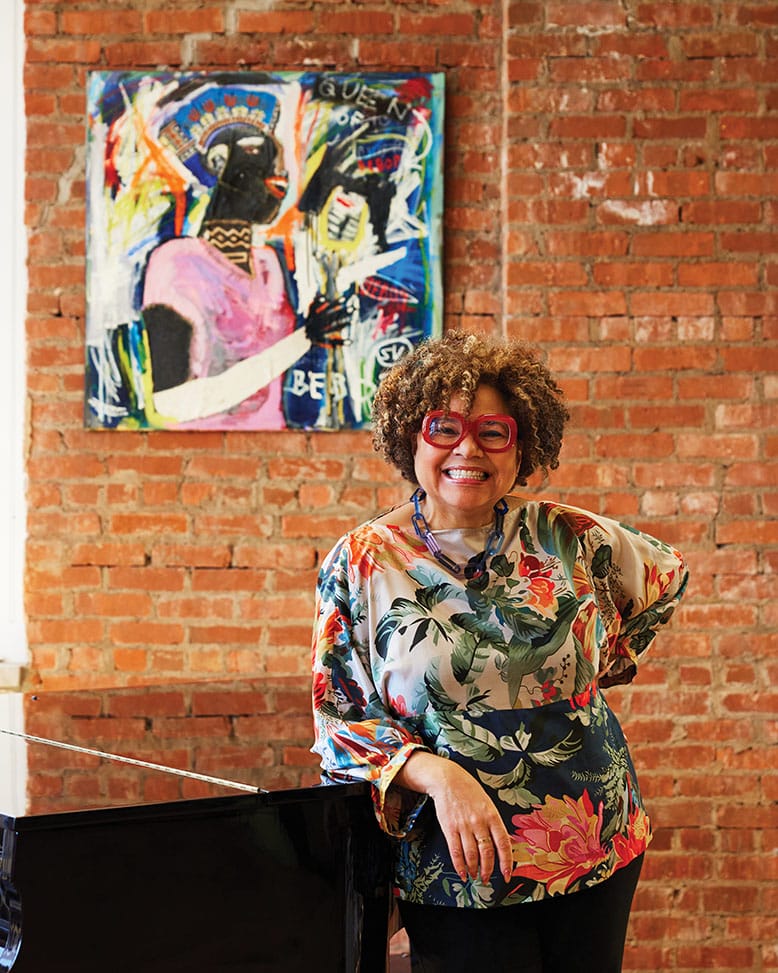
Melissa Walker, founder of the Montclair Jazz Festival, at the Montclair headquarters of Jazz House Kids, the music-education nonprofit she founded. Photo: Natalie Chitwood
The Montclair Jazz Festival has come a long way from its humble beginnings, when a handful of Melissa Walker’s jazz-camp students held an impromptu concert in Nishuane Park in 2010. On September 13, more than 25,000 people are expected for the 16th annual festival, the largest free jazz festival in the New York/New Jersey area and one of the largest free festivals in the country. Big names in the genre, such as saxophonist Lakecia Benjamin, vocalist Jazzmeia Horn, and Christian McBride and Ursa Major, will play on two main stages along Bloomfield Avenue in downtown Montclair, which will be closed to cars all day. Hundreds of food and craft vendors will line the streets. In the evening, McBride will spin records, and thousands of festival-goers will dance on Bloomfield Avenue.
The outsize success of the Montclair Jazz Festival reflects Walker’s single-minded passion for her music-education nonprofit, Jazz House Kids, and its goal of putting an instrument into every child’s hands. The longtime Montclair resident, a jazz vocalist, founded and runs the festival as a fundraiser for the nonprofit and as a showcase and inspiration for its students.
She is married to McBride, a nine-time Grammy Award-winning bassist, who is the artistic director of Jazz House Kids and curator of the Montclair and Newport jazz festivals.
Based in a 4,500-square-foot space downtown that will soon undergo an expansion to more than double its size, Jazz House Kids teaches students from more than 40 school districts in New Jersey and even some from New York and Pennsylvania. “Every day of the week you will find the Jazz House hopping,” Walker says with her trademark throaty laugh.
Jazz House students earn their performing chops in Manhattan at Dizzy’s Club at Lincoln Center, Carnegie Hall, the MetJazz Gallery, the Metropolitan Museum of Art, regional and international festivals, and during a series of free outdoor concerts in Montclair every summer. The series is sponsored by the Wellmont Arts Plaza and the New Jersey Hall of Fame.
Many alumni of the program have gone on to Juilliard and other conservatories and have become well-known jazz musicians, including Matthew Whitaker, Emmet Cohen, Isaiah J. Thompson, Immanuel Wilkins, Zoe Obadia and Wallace Roney Jr.
The program’s goal is not to help kids reach the highest echelons of jazz, but to make music and instruments accessible, especially to kids who couldn’t otherwise afford it. Close to half of Jazz House students get financial aid, and auditions are held only to place aspiring musicians. “We never turn anyone away,” Walker says.
The program does more than teach kids how to play, she says; it builds confidence and provides a sense of belonging. “There is so much angst among kids today, but with Jazz House, they have a community that will rally around them and support them even after they graduate,” she says.
Jazz House Kids’ reach goes far beyond Montclair, bringing teachers and instruments to underserved school districts in Essex, Union and Passaic counties. A new collaboration with Trinity Church in downtown Manhattan has Jazz House instructors giving free music lessons to city kids enrolled in an after-school program.
The nonprofit does not have a one-size-fits-all approach. “We’ll embed teachers into school programs; we’ll help a district with a concert band that wants to explore jazz or one that really wants to work on their brass; we might bring in Spanish-speaking instructors. We’re here to make sure that young people can gain all the benefits and joy of having access to music,” says Walker.
“We’ve invested in bringing back this ecosystem that has been lost as arts have been so dramatically impacted by cuts in budgets.”
Supporting young female musicians in a genre traditionally dominated by men is another goal. They are nurtured through the nonprofit’s CHiCA Power initiative, which began when young saxophonist Zoe Obadia lamented the lack of female compatriots in the program. It has boosted the number of girls at the Jazz House from 7 percent to an average of 35 percent.
The September 13 festival follows a summer of free jazz performances at the Wellmont Arts Plaza that include ten big bands and student showcases. On that evening, along with thousands of festival-goers of all ages and walks of life, Walker will be on Bloomfield Avenue swaying to the music as her husband, under the moniker DJ Brother Mister, spins records.
“It has always been my personal dream to see people dancing in the streets,” Walker says.