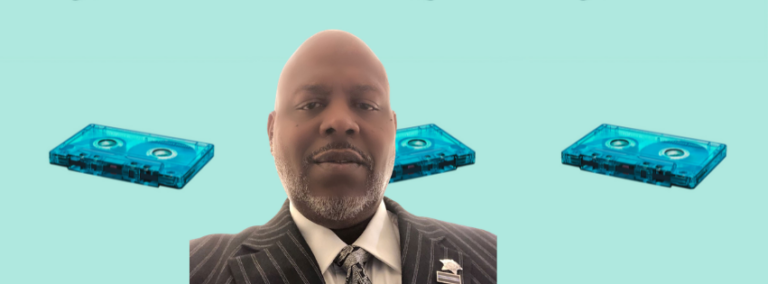

Tony Exum Jr. is Cold
The saxophonist has spent his career moving easily between jazz, R&B and funk. With a distinctive sound, a broadcaster’s understanding of the music and an instinct for reaching beyond genre, Tony Exum Jr. continues to make his own case for where contemporary jazz can go next.
There is a particular kind of cold that has nothing to do with temperature. Musicians and audiences know it when they hear it. It’s in the confidence to enter a song, find the pocket and leave a signature without overwhelming everything around it. The ability to thread the needle effortlessly. It is the ability to make an instrument sound less like an instrument and more like a voice. Tony Exum Jr. is that kind of cold.
For listeners who have followed the Colorado-based saxophonist, his appearance on Heidi Tann’s “Coffee On Your Sleeves” feels less like a departure than another chapter in a musical philosophy Exum has been developing for years. Jazz, in his view, does not have to remain confined by the boundaries of jazz.
Released August 7, 2026, “Coffee On Your Sleeves” brings together contemporary jazz, soul and R&B, with Tann on vocals and Exum providing the saxophone voice. The recording also features Bruno Nesci on guitar and Frank Reina on drums, with production involving Bobby Gomez, Heidi Tann and LaVelle Powell and mastering by Grammy-winning engineer and producer Pete Tokar. The song is the first release from Tann’s forthcoming Silk n’ Soul album.
For Exum, the intersection of jazz and R&B is familiar territory. His music has increasingly centered on what he calls “Rhythm N Smooth,” a blend of jazz, R&B and funk that reflects both his influences and his refusal to be boxed into one corner of contemporary music. His career has included charting singles, festival appearances, radio and a growing body of work that places groove at the center without surrendering the musicianship behind it.
The crossover is not simply a matter of positioning. It reaches back to the beginning of his musical life.
When Exum appeared on The Paula Atherton Show on Keymark Television Network, he traced his relationship with the saxophone to his uncle, Larry Francis. As a child, Exum spent summers in Colorado Springs, where he watched his uncle perform. At a concert at Fort Carson, an 11-year-old Exum saw Francis holding an audience with his saxophone and made a decision that would shape the rest of his life. He wanted to do that, too. His uncle gave him an old horn, his own first saxophone and Exum began playing.
The music surrounding him was just as important as the instrument. Exum grew up hearing Grover Washington Jr., Jeff Lorber and David Sanborn, along with the crossover jazz that flourished during the period. There was Charlie Parker and John Coltrane, too, as well as George Howard and the emerging generation of saxophonists who demonstrated just how broad the instrument’s vocabulary could be. Exum absorbed all of it.
That history helps explain the musician he became. Exum understands the language of jazz, but he also understands the groove, economy and immediacy of R&B. He has never seemed particularly interested in pretending those things have to live separately.
During his conversation with Paula Atherton, Exum spoke at length about the relationship between contemporary jazz and R&B and his desire to reach listeners beyond the traditional smooth-jazz audience. His reasoning was rooted partly in history. There was a time, he recalled, when contemporary instrumental music lived comfortably on R&B and urban contemporary radio. Jazz artists appeared in spaces where genre lines were considerably less rigid, and audiences encountered the music without necessarily worrying about what category it belonged to.
Exum sees something worth recovering in that relationship. Much of contemporary smooth jazz, he observed, already shares the musical architecture of R&B and pop. What jazz musicians bring to it is their phrasing, improvisation and individual musical language. His interest in reaching R&B listeners, then, is less about leaving jazz behind than acknowledging a connection that has been there for decades.
That makes “Coffee On Your Sleeves” a particularly natural setting for him. Exum is not visiting somebody else’s musical neighborhood. In many respects, he has spent his career arguing that the neighborhood was shared all along.
There is another side to Exum’s perspective that distinguishes him from many recording artists. He does not simply make records; he has spent years programming and presenting them. As a radio personality with Jazz 93.5 FM in Colorado Springs, he has occupied the other side of the microphone, introducing listeners to contemporary artists while maintaining a connection to the musicians who built the genre.
He describes programming devoted to a newer generation of smooth-jazz artists alongside shows reaching back into the music of the 1970s, ’80s and ’90s. His playlists allowed Grover Washington Jr., George Duke, David Sanborn and their contemporaries to coexist with musicians carrying contemporary jazz forward.
That vantage point has given Exum an unusually broad view of the business. He is not merely trying to locate himself within a format; he has spent considerable time thinking about the format itself where the music came from, how audiences discovered it, why some of those avenues disappeared and where the next listeners might be found.
His answer has often been remarkably uncomplicated: go where the people are.
During a Paula Atherton Show interview, Exum recalled playing a festival built around chicken wings, hardly the setting one might associate with a conventional smooth-jazz bill. It did not matter. There was an audience, the audience wanted music, and some of those people became fans. For Exum, the experience reinforced an idea that has informed his approach to performing: genre should describe the music, not dictate where an artist is permitted to take it.
The stages have grown considerably larger over the years. Exum has appeared at the Berks Jazz Festival, San Diego Smooth Jazz Festival and Myrtle Beach Jazz Festival. In January 2025, he performed the national anthem at SoFi Stadium for the Los Angeles Rams.
His recording career has developed alongside those performances. “My Name Is Tony,” released in 2019, spent 12 weeks in the Smooth Jazz Network Top 100. His catalog includes the albums Finally and The One, and his work since then has continued to refine the muscular, R&B-informed saxophone sound that has become his calling card.
There is a certain symmetry, then, in hearing Exum on a record such as “Coffee On Your Sleeves.” The saxophone sits naturally inside the soul setting, not as an ornamental jazz feature added to a vocal track, but as part of the conversation. It is precisely the sort of musical exchange Exum has been talking about for years.
Perhaps the most revealing moment Tony has shared recently, had little to do with charts, festivals or career milestones. It concerned the less glamorous business of staying in the business.
Music changes. Radio changes. Formats disappear. Audiences move. Independent artists are expected to navigate all of it while continuing to create. Exum recalled advice from his manager that distilled the appropriate response into three words: “pivot, not panic.” His own addition was equally straightforward. Keep putting out good music.
It is difficult to find a better summary of his career.
The 11-year-old who once watched his uncle command a crowd eventually became the young musician grinding through local gigs and opening for established acts. He became a recording artist, a festival performer and a broadcaster. He stood with a saxophone inside an NFL stadium. Now his horn turns up alongside Heidi Tann on a sophisticated soul record, doing what Exum has long believed contemporary jazz should be able to do: travel.
Tony has the supreme technical ability that what he leaves out can matter as much as what he plays.
That may be where Tony Exum Jr.’s particular kind of cold really resides. It is in the identity of the sound, in knowing the musicians who came before him without becoming an imitation of them, and in understanding that reaching a larger audience does not require surrendering the qualities that made the music worth hearing in the first place.
Years after Larry Francis placed that first saxophone in his nephew’s hands, Tony is still following the sound that began there. The rooms are larger now. The records travel farther. The musical neighborhood has expanded.
The horn is on fire and Tony Exum Jr. remains cold.
Stream Tony Exum Jr. wherever you stream your music.
Follow @texumjrsax
Visit TonyExumJr.com for more information
Keymark Television Network is committed to highlighting the stories, artistry, and achievements of creators, entrepreneurs, and cultural innovators across the globe. Through exclusive interviews, original programming, and special features, Keymark Television Network delivers compelling content that informs, inspires, and connects audiences worldwide. The television and media network partners with both established and emerging voices, bridging entertainment and empowerment through storytelling that leaves a lasting mark.
Contact:
Communications Department
Keymark Television Network
communications@keymarktelevision.com